
As Twitter continues to lose advertisers and careens from one controversy after another, users are being reminded of the many downsides of centralized social media platforms, namely de-platforming, censorship, privacy violations, data breaches, server outages and finicky owners.
To sidestep these issues, some social media users are turning to decentralized blockchain-based social media (BSM) platforms such as Steemit, Minds, Hive and others. Many decentralized social media platforms serve as alternatives to their more mainstream counterparts, such as Facebook, LinkedIn, Twitter and TikTok.
Decentralized social media are platforms where users retain ownership over the content they create and where their content is stored on independent servers, instead of centralized servers owned by a single firm. Like their centralized counterparts, blockchain-based platforms also allow users to follow, be followed and share information and content with their followers.
Adoption and Use of Decentralized Blockchain-based Social Media (BSM) Platforms
In a new study, “Decentralizing Social Media: An Examination of Blockchain-based Social Media Adoption and Usage,” researchers Anatoliy Gruzd, Alyssa Saiphoo and Philip Mai set out to understand why some social media users are choosing to use blockchain-based social media (BSM) platforms.
The study was presented at the recently concluded 2023 ACM Hypertext and Social Media Conference in Rome, Italy (Sep. 4-8) and is part of a larger Canada Research Chair-funded initiative led by Dr. Gruzd examining the use of decentralized platforms and assessing their potential as disruptors in the social media space.
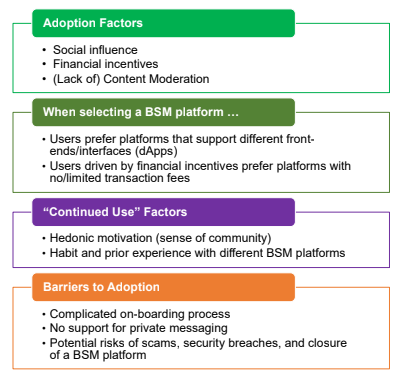
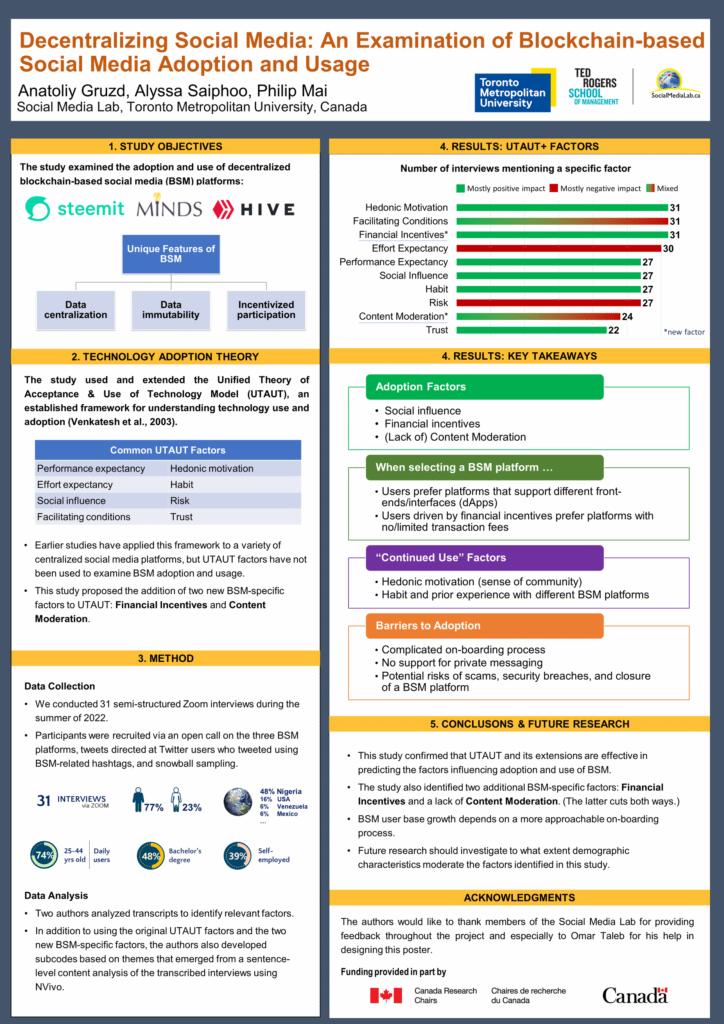
The team conducted 31 semi-structured interviews with early adopters of BSM platforms. Guided by the Unified Theory of Acceptance and Use of Technology (UTAUT) model, their manual examination of the interviews reveals that users’ adoption of BSM is primarily motivated by social influence, financial incentives and a desire to bypass the content moderation policies implemented by mainstream social media platforms such as Facebook, X and TikTok.
At the same time, the decision to continue using a BSM platform was driven by factors such as hedonic motivation (e.g., the enjoyment of using BSM and a sense of community), as well as habit and prior experience with other blockchain apps.
While all the users interviewed enjoyed using various BSM platforms, challenging onboarding processes, the absence of support for private messaging, and the potential for fraud are major obstacles to the wider adoption of these decentralized social platforms.
Research Poster
For more details about this study see the accompanying research poster below.
Citation:
Gruzd, A., Saiphoo, A., & Mai, P. (2023, September). Decentralizing Social Media: An Examination of Blockchain-based Social Media Adoption and Use based on the Unified Theory of Acceptance and Use of Technology (UTAUT) Blockchain-based Social Media Adoption and Use. In Proceedings of the 34th ACM Conference on Hypertext and Social Media (pp. 1-2). Available at https://doi.org/10.1145/3603163.3609030