“Helping You Share What You Know, Where It Matters Most“
At a time when public trust in institutions is fragmented and misinformation spreads faster than evidence, researchers and experts face a critical challenge: how to ensure their work is not only accurate but also accessible, relevant, and impactful.
To meet this challenge head-on, the Social Media Lab at Toronto Metropolitan University is proud to present KM Compass, a free, web-based, open-source knowledge mobilization (KM) app designed to help researchers, institutions, and knowledge mobilizers across various disciplines choose the best strategies for turning their knowledge into action and impact. Whether you’re just beginning your KM journey or refining an existing plan, KM Compass provides a clear and user-friendly roadmap to guide your efforts.
Turning Ideas Into Impact
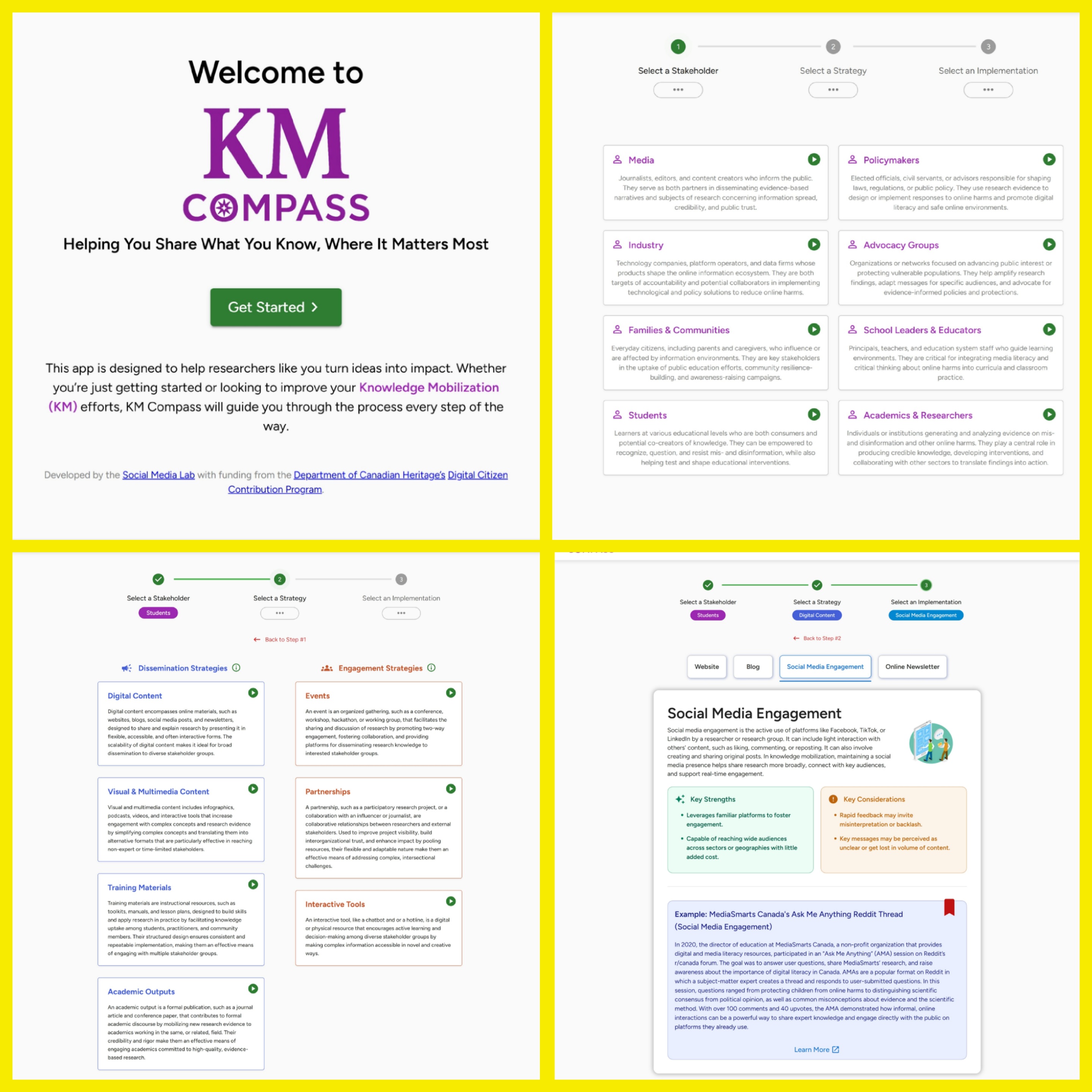
Funded by the Department of Canadian Heritage’s Digital Citizen Contribution Program and developed through a comprehensive review of over 40 knowledge mobilization frameworks across disciplines, KM Compass distills knowledge mobilization into three core, actionable steps:
- Identify key stakeholders, such as policymakers, community organizations, the media, students and many others.
- Select an appropriate KM strategy, choosing from a variety of time-tested dissemination and engagement strategies, from passive formats that focus on one-way communication that shares research evidence with general or targeted audiences using accessible and engaging formats to more interactive approaches that emphasize two-way communication that actively involves stakeholders in the interpretation, adaptation, or co-creation of knowledge.
- Select an implementation, choosing from a library of standard options, such as infographics and policy briefs, as well as workshops, co-creation sessions, hackathons, and working groups.
Each step is designed to help researchers think strategically about who they wish to reach with their work, especially in an environment where the traditional top-down model of expert communication has broken down. The app not only provides a practical framework for making research more accessible and useful, but it also connects users with curated resources and real-world examples for engaging diverse audiences.
 The Social Media Lab is an interdisciplinary research center at the Ted Rogers School of Management, part of Toronto Metropolitan University. The lab examines how social media and other digital technologies, such as AI, are transforming the way people and organizations communicate, disseminate information, conduct business and form communities, and how these changes impact society. The broad aim of the lab’s various research initiatives and digital tools is to advance the public’s understanding of the benefits and pitfalls of adopting new technologies with a focus on addressing the erosion of information integrity online.