
“What happens when the digital town square becomes a digital battleground?”

In an era defined by overlapping global crises and hardening borders, immigration is no longer just a wonky policy issue. It’s a cultural flashpoint, amplified and refracted through the algorithmic lens of social media. In Canada, as in many nations grappling with a “polycrisis” of economic instability, climate change, and political polarization, TikTok has emerged as a surprisingly potent space for shaping public perception of immigrants and migration. But what’s unfolding on this platform is not simply a battle of facts or ideologies. It’s a dynamic interplay of storytelling, performance, and digital affordances, where the same tools that foster connection and inclusion can also be weaponized to exclude and harm.
In a new paper published in Media and Communication, “Same Platform, Different Stories: TikTok and the Battle Over Immigration Narratives,” researchers William Hollingshead, Anatoliy Gruzd, and Philip Mai examined the increasingly polarizing online discourse about immigration. Specifically, they set out to understand how TikTok’s unique culture of mimesis (imitation/trends) and interactivity shapes the way people talk about immigration in Canada. The researchers tackled two core questions:
- How do popular TikTok videos frame the topic of immigration?
- What is the relationship between a TikTok video’s stance on immigration and its use of audio, visual, and sharing affordances that derive from or promote mimesis and interactivity?
The Method: How the Data was Collected and Analyzed
To find the answers, the researchers used Zeeschuimer, a semi-automated web-crawling tool, to collect 5,305 public TikTok videos featuring immigration-related terms and hashtags. From this pool, they focused on a sample of 344 English-language videos posted in 2025. Each of these videos had at least 100,000 plays and was highly likely to have reached Canadian audiences.
Next, they developed and applied a detailed manual coding schema to categorize the rhetoric used in these viral videos. Specifically, they looked for:
- Pro-immigration frames: Arguments centred on multiculturalism, humanitarianism, successful cultural integration, and economic benefits.
- Anti-immigration frames: Arguments centred on nationalism, perceived cultural or security threats, integration challenges, and economic or administrative costs.
The Findings: What the Data Tells Us
1. The Battle for the Narrative: Pro- vs. Anti-Immigration
Despite the often negative reputation of social media comment sections, the researchers found that positivity is actually leading the way (at least in their sample). Contrary to expectations, 41% of the popular videos studied were pro-immigration (see Figure 1).
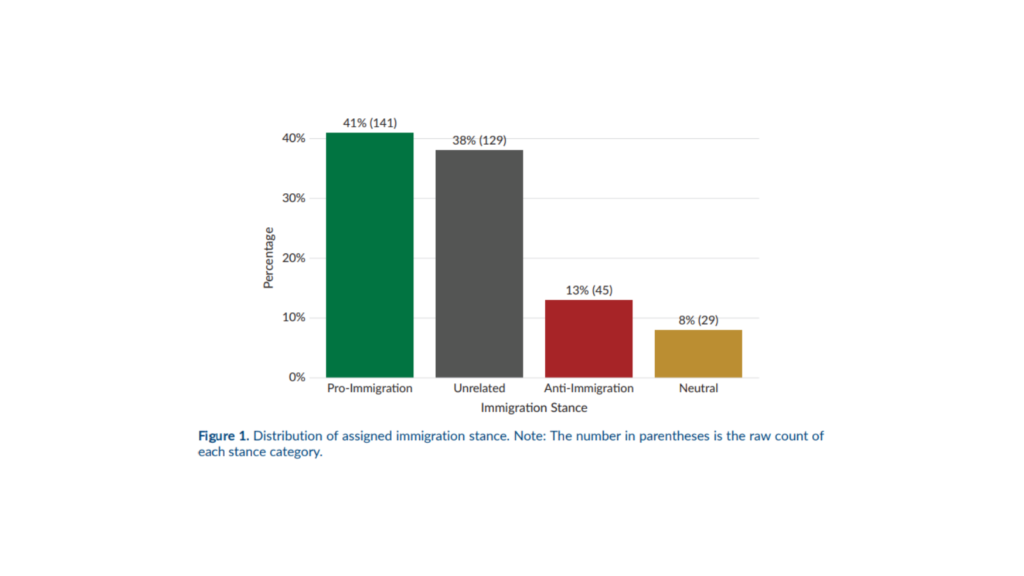
The most common theme in pro-immigration videos is the orderly, legal nature of the immigration process, framing immigrants as patriotic and law-abiding. This included videos featuring professional advice from regulated consultants, peer-to-peer support, and celebrations of milestones such as permanent residency or citizenship. This is a crucial finding, as it directly contrasts recent public sentiment suggesting that Canada’s immigration system is “broken” or that newcomers don’t share national values.
On the flip side, the pushback against immigration tends to focus on two main pillars: costs and culture. 47% of anti-immigration videos used an economic lens to blame newcomers for Canada’s financial pressures, such as inflation, stagnant wages for native-born Canadians, and the housing crisis (see Figure 2).
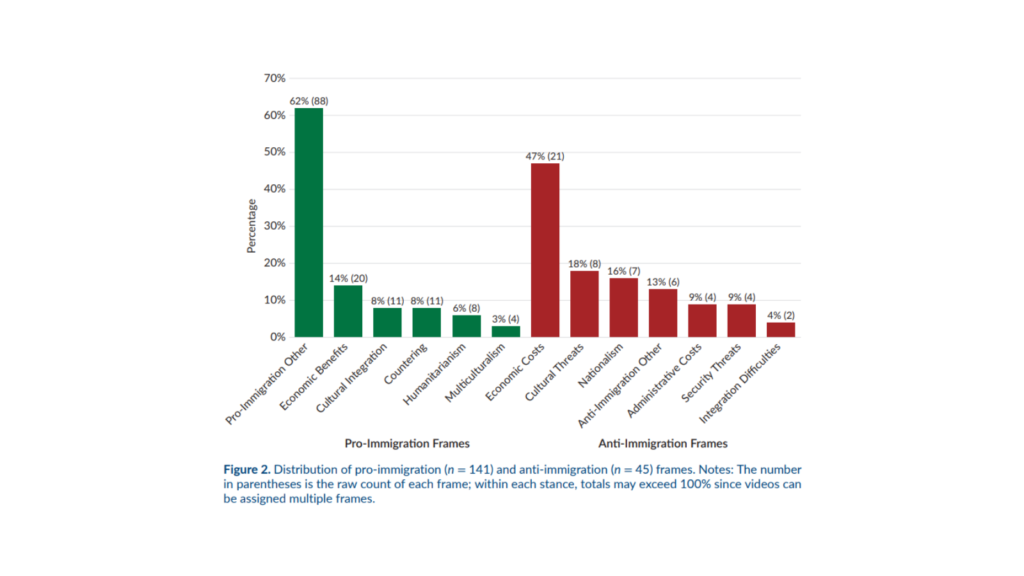
Beyond the wallet, about a third of anti-immigration content leaned into identity politics, tapping into frames like cultural threats (18%), nationalism (16%), and integration difficulties (4%). These videos reinforce a tense narrative divide between “real” Canadians and immigrants.
2. Why “Audio Memes” work for some, but not others
The researchers also wanted to know whether a video’s stance on immigration (pro-, anti-, or neutral) related to how creators used TikTok’s affordances. Following their analysis, they found one major statistical difference: the use of non-original audio.
Pro-immigration creators relied more on “audio memes.” They use trending sounds as a template, weaving their personal migration stories into viral formats that feel communal and celebratory. This “remix” style is perfect for telling human stories.
In contrast, anti-immigration content tended to be much more impersonal and documentary in style. This “voice-over” approach doesn’t easily translate into a trend that others want to copy. It turns out that TikTok’s features aren’t just neutral buttons. Some may be suitable for telling some stories, but incongruent with others.
Why This Matters
TikTok is no longer just for dance challenges; it’s where a rapidly increasing number of Canadians go to learn, build community, and engage politically.
The findings suggest that while TikTok can be a tool for exclusion, its very structure, such as its “mimetic logic”, offers a powerful tool for civil society to build resilience against disinformation and discrimination by leaning into the storytelling formats that the platform does best.
While the researchers’ focus was on Canada, the study’s methodology can be applied to explore how short‐video platforms mediate other contentious issues in other countries. Furthermore, because TikTok’s Research Tools API is available only in a limited number of jurisdictions (e.g., the EU, UK, and US), the approach enables researchers elsewhere to investigate similar questions about immigration and other social issues.
To learn more about this study, check out the full paper here.
____________________________________________________________________________
Citation: Hollingshead, W., Gruzd, A., & Mai, P. (2026). Same Platform, Different Stories: TikTok and the Battle Over Immigration Narratives. Media and Communication, 14, Article 11409. https://doi.org/10.17645/mac.11409