
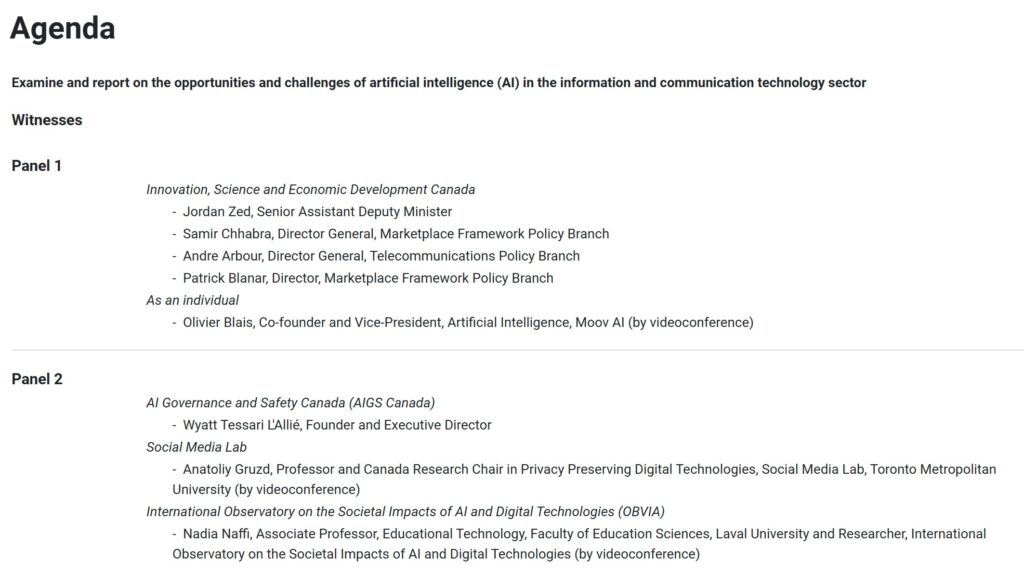
Anatoliy Gruzd, co-director of the Social Media Lab addressed the Standing Senate Committee on Transport and Communications on November 25, 2025, as part of its review of the opportunities and challenges posed by artificial intelligence in the information and communication technology sector.
His opening statement is included below.
You can watch the video recording of the session at
https://sencanada.ca/en/committees/TRCM/noticeofmeeting/677808/45-1




Opening Statement by Anatoliy Gruzd
Mr. Chair and Committee Members, thank you for inviting me to discuss the opportunities and challenges that AI brings to Canada’s ICT sector.
I am Anatoliy Gruzd, a Canada Research Chair and Professor at Toronto Metropolitan University. My remarks focus on two key areas: the adoption of generative AI in Canada and its use by malicious actors to create and disseminate disinformation. This reflects my research conducted with my colleague Philip Mai and other collaborators at the Social Media Lab, where we study how manipulated content spreads and how digital platforms shape public opinion.
Generative AI Use and Adoption in Canada
On the first issue, generative AI tools are changing how people create content, search for information, and make sense of the world. Their rapid and often uncoordinated integration across products is speeding up adoption. But it also leads to serious consequences.
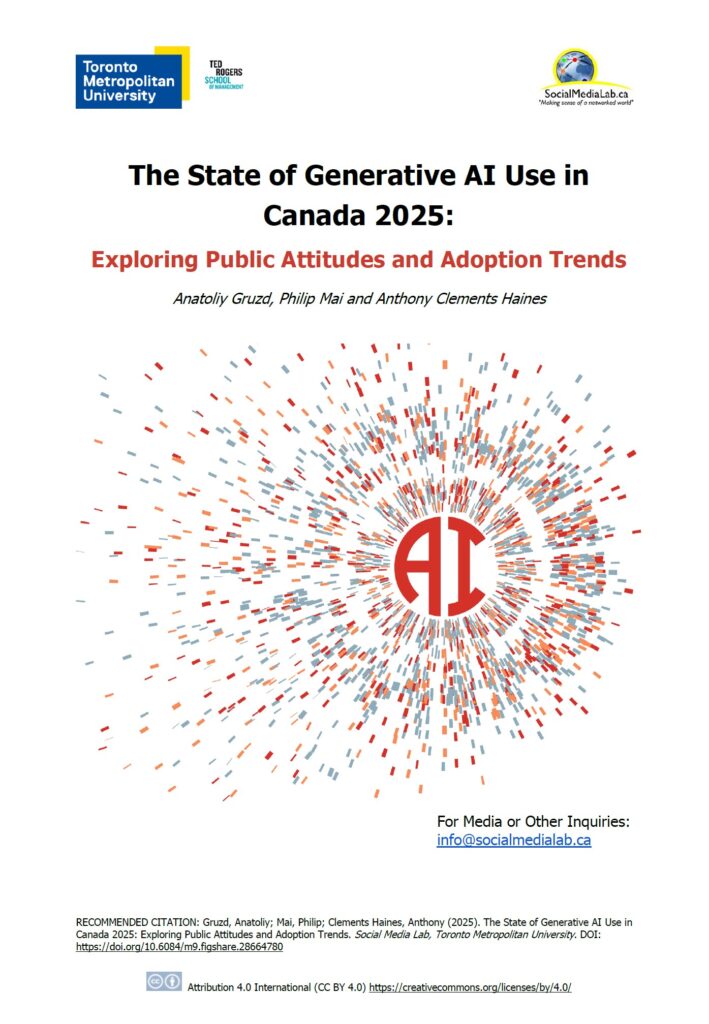
In our new study, The State of Generative AI Use in Canada, about two-thirds of Canadians said they had tried generative AI. But, only 38% felt confident using it effectively, and only 36% understood the rules and ethics behind responsible use. This suggests a growing gap between how widely these tools are used and how prepared people are to use them safely.
Our survey also reveals that 67% are concerned that generative AI could be used to manipulate voters or interfere with democratic processes. 59% report having less trust in online political news due to fears that it may be manipulated.
Canadians also strongly support regulation. A substantial majority (78%) believe AI companies should be held responsible when their tools cause harm. This final statistic makes one thing clear: accountability should rest with the companies that build, release, and profit from AI systems.
Generative AI and Disinformation by Malicious Actors
On the second issue, the same features that make these tools popular also make them appealing to malicious actors. AI can clone voices, manufacture events, and impersonate officials, which makes it harder for the public to know what is real.
Recent cases demonstrate the severity of this issue. In 2025, senior officials in Europe and the United States received AI‑generated messages that pretended to be from U.S. Secretary of State Marco Rubio. These messages included synthetic audio, showing how easily unknown actors can reach high-level officials using tools available to almost anyone.
In another example, groups like the Institute for Strategic Dialogue documented a similar pattern in a Russian-linked operation called “Operation Overload” or “Matryoshka.” It included tactics such as the use of fabricated voice-overs to impersonate news outlets and experts. The goal was to spread misleading narratives about Western institutions and Ukraine.
Increasing Transparency Around AI‑Generated Content
These examples highlight the need for greater transparency. Many AI systems already embed so-called “content credentials” in the form of watermarks and metadata to show when content is synthetic. Industry-led initiatives, such as the Coalition for Content Provenance and Authenticity (C2PA), have developed credentials for this purpose, but adoption is still low. Even when content carries these signals, major social media platforms often remove or fail to display them after the content is uploaded.
This shows the limits of self-regulation. Platforms have conflicts of interest. Synthetic content is cheap to produce and is often highly engaging, which benefits business models built on the attention economy. Most policies are also voluntary, selectively applied and reversible.
Recommendations
Canada should take a more proactive step by requiring providers of high-risk generative AI systems and large platforms that operate here to support, retain, and display standard authenticity metadata. This is especially important for political and news-related content. It would ensure that provenance signals are applied at the point of content creation and preserved at the point of distribution.
Canada also needs to reinforce its information ecosystem. Canadians should have access to clear labels and online tools that help them verify synthetic media and use AI responsibly. Public officials need training to recognize and respond to AI-driven spam messages and impersonation attempts.
Canadians want responsible innovation. To build trust and reduce harm, we need to set clear expectations for AI companies and invest in capacity building across the information environment.