
What happens when one of the world’s biggest wars plays out on one of the least understood platforms?
In the aftermath of Russia’s full-scale invasion of Ukraine on February 24, 2022, Telegram quietly became one of the most important, yet least understood, platforms for following the war. As mainstream news outlets struggled to keep up with the pace of real-time developments and access to verified information became harder to come by, many people turned to Telegram channels for updates. These Telegram channels included everyone from anonymous military bloggers to official government accounts to meme-heavy commentary feeds. The result? A chaotic, unfiltered, and incredibly influential ecosystem of war-related content, much of which targets audiences far beyond Ukraine or Russia.
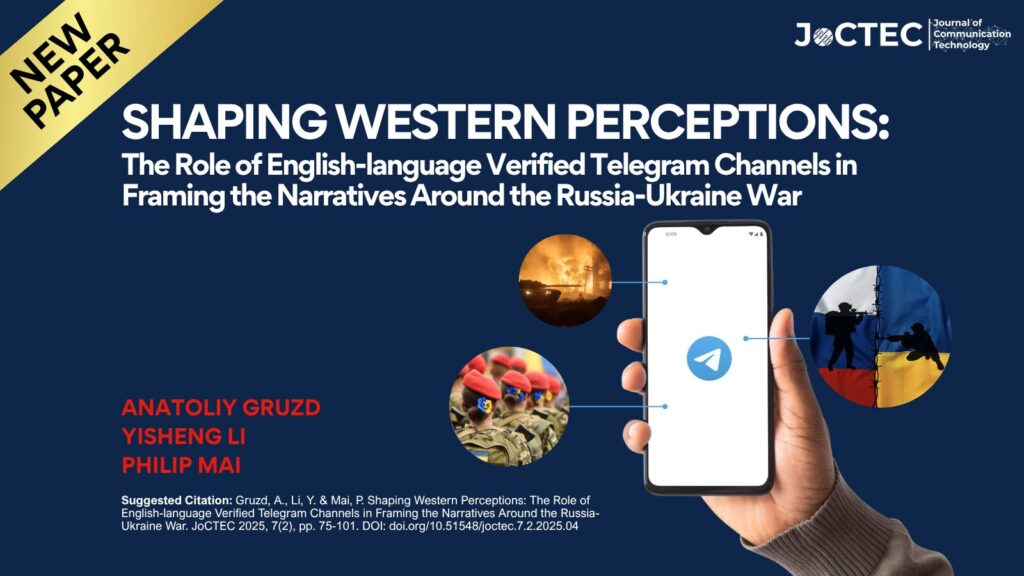
In a new paper, “Shaping Western Perceptions: The Role of English-language Verified Telegram Channels in Framing the Narratives Around the Russia-Ukraine War,” by Anatoliy Gruzd, Yisheng Li and Philip Mai, published in the Journal of Communication Technology (JoCTEC), we examine the role that English-language verified Telegram channels play in shaping the global conversation about the war. These aren’t just any Telegram accounts. To earn verification, a channel must be linked to prominent accounts on other social media platforms and be referenced by reputable English-language media outlets. That makes them particularly interesting: they’re more likely to be seen as trustworthy by users and more likely to have significant reach and impact.
Our research examines which verified English-language Telegram channels are actively posting about the war, as well as the topics, narratives, and framings they’re sharing. This matters because the war isn’t just being fought on the ground: it’s being fought through storytelling. Governments, influencers, and anonymous actors are all working to control the narrative, whether by framing one side as the aggressor and the other as the victim, or by questioning the legitimacy of foreign aid, Western involvement, or even the basic facts of the war.
Why Telegram? And Why Should You Care?
Telegram offers a unique environment for this kind of narrative warfare. Unlike X or Facebook, Telegram enables large-scale broadcasting with minimal moderation. Posts can go viral without being fact-checked. And while many users might assume they’re just reading frontline updates or independent commentary, the reality is more complicated. Our new research suggests that non-state Telegram channels can act as conduits for pro-Kremlin messaging, intentionally or unintentionally, by sharing posts from Russian state-affiliated sources or indirectly amplifying their messaging. At the same time, Ukraine has been using Telegram to push back, employing the platform to counter disinformation, provide official updates, and reframe narratives in its favour.
Narratives, Counternarratives, and the Fight for Meaning
While the war itself is happening in Eastern Europe, the stories shared on Telegram are often aimed at Western audiences. English-language content focuses on hot-button topics such as military aid, Western sanctions, and NATO involvement, all of which directly affect policy decisions in countries like Canada, the UK, and the US. And with public opinion increasingly polarized, these narratives can influence not only how people feel about the war but also what governments ultimately choose to do about it.
Our study brings clarity to this space by mapping the information ecosystem surrounding verified English-language Telegram channels and identifying the types of content they share. It offers insights into how propaganda spreads, how legitimacy is constructed online, and how social media platforms, especially less-regulated ones like Telegram, are becoming central to modern conflicts.
The Data and Our Questions
Using a snowball sample of 21,907 Telegram channels, we identified 55 English-language verified channels linked to war-related content. Using the research tool Communalytic, we ran a semi-automated topic analysis. We examined 125,840 public posts from these channels, posted within the first year of the 2022 Russian invasion. We used our data to answer the following two questions:
RQ1: Who’s Driving the Conversation on Telegram?
Based on the manual review of the 55 verified, English-language Telegram channels linked to the discussion of the Russia-Ukraine war, several key trends emerged:
- News Delivery Shift: The presence of both mainstream and alternative media, alongside journalists and influencers, underscores Telegram’s increasing role as a news platform.
- Right-Leaning Dominance: Most channels in the sample leaned politically to the right or far right. Many had links to Russian or pro-Russian accounts in the Telegram post-sharing network, raising concerns about bias and misinformation.
- Covert Kremlin Influence: Some influencers were connected to media operations allegedly backed by RT (Russia Today)—a tactic the Kremlin uses to amplify propaganda through unofficial, Western-friendly voices.
- State-Affiliated Accounts: Only eight verified, English-language channels were officially tied to the Russian or Ukrainian governments. While Ukraine has increased its digital outreach, the larger Telegram network data suggests limited reach for pro-Ukraine accounts.
- Crypto Channels: Several channels focused on cryptocurrencies and blockchain, possibly linked to sanction evasion or war fundraising—a trend worth further study.
RQ2: What Topics Are These Channels Pushing?
Out of the 125,840 posts from these 55 verified English-language channels, only 21% directly addressed the Russia-Ukraine war. The rest leaned heavily into partisan and geopolitical themes, particularly U.S. domestic issues. Below are the top 6 topics discussed by these channels:
- U.S. Politics: Anti-Biden, pro-Trump, and conservative culture war narratives (e.g., LGBTQ issues, gun control, abortion).
- Russia-Ukraine War: War updates, humanitarian impacts, economic fallout, and calls for military/humanitarian aid.
- Cryptocurrency: Financial updates, NFT promotions, and some content around crypto donations and sanction evasion.
- China-Taiwan-West Tensions: Warnings about China’s growing threat and Biden’s weak foreign policy.
- Israel-Palestine Conflict: Accusations of Western double standards and indirect comparisons with Ukraine.
- Elon Musk/Twitter: Posts celebrating Musk’s takeover as a win for “free speech” and the far-right.
Broader Implications and Conclusions
Overall, while Russia and Ukraine leverage Telegram to reach global audiences, Russia currently holds the strategic advantage due to its larger, more interconnected presence, stronger resonance with far-right Western audiences, and its effective use of unofficial influencers to circumvent platform restrictions.
Pro-Russian channels on Telegram employ long-standing narrative strategies that blame the West for escalating the conflict, emphasize Western domestic crises, and amplify divisive social and political issues such as LGBTQ rights, immigration, and inflation. Telegram’s lenient moderation policies have made it a hub for far-right communities, providing fertile ground for the spread of partisan and Kremlin-aligned content. As a result, English-speaking users seeking credible war news on the platform face a high risk of exposure to biased or misleading information, particularly from politically extreme sources.
⚠️Caution is advised when using Telegram as a news source, especially for English-speaking users. Without context or verification, users may be unknowingly consuming content aligned with Kremlin talking points or extremist agendas.
If you’re interested in digital propaganda, online influence campaigns, or how global conflicts are reframed for international audiences, this paper offers a fresh perspective on one of the most important information platforms you might not be paying enough attention to. You can read the full paper here:
Citation: Gruzd, A., Li, Y. & Mai, P. (2025). Shaping Western Perceptions: The Role of English-language Verified Telegram Channels in Framing the Narratives Around the Russia-Ukraine War. JoCTEC 7(2), pp. 75-101. DOI: doi.org/10.51548/joctec.7.2.2025.04