
FOR IMMEDIATE RELEASE
July 25, 2025
Toronto, ON — The Social Media Lab at Toronto Metropolitan University is pleased to announce a major update to PoliDashboard.org, a free public web app that enhances transparency around paid political advertising on Meta’s platforms, including Facebook and Instagram.
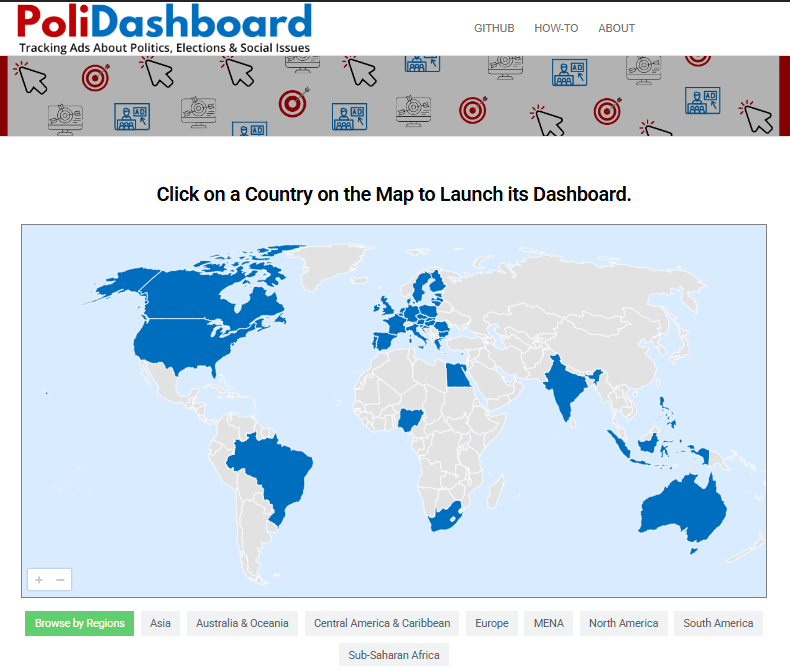
PoliDashboard collects and visualizes real-time data from Meta’s Ad Library to reveal who is placing ads about politics, elections and social issues, how much they’re spending, and which audiences are being targeted. The dashboard features ad data from over 35 major countries, with more on the way. It is designed to empower journalists, watchdog organizations, researchers, and voters to explore and understand patterns in political messaging and campaign strategies across multiple countries.
This latest update is designed to increase accountability and reduce the risk of manipulation of political ads by both foreign and domestic actors. It delivers powerful new features and performance upgrades aimed at deepening public insight into the use of targeted online ads:
1. AI-Generated Ad Summaries
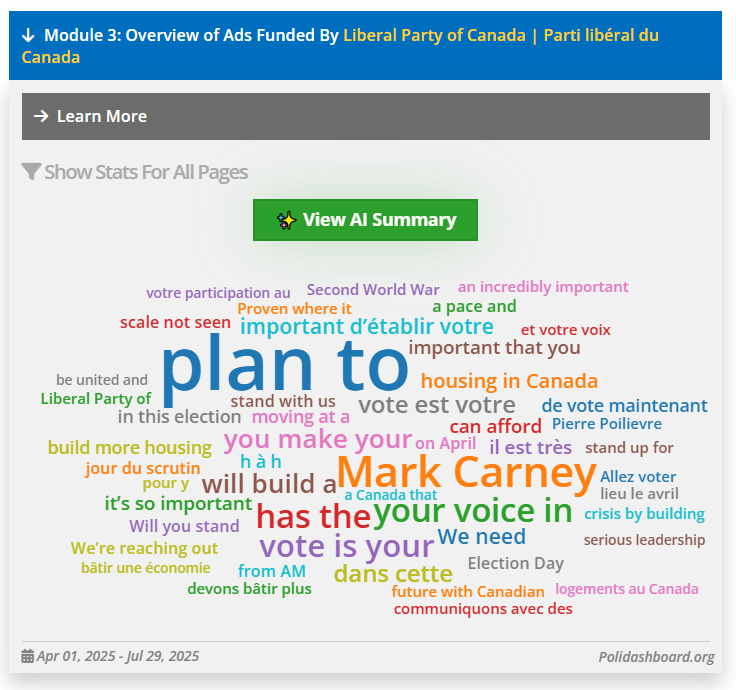
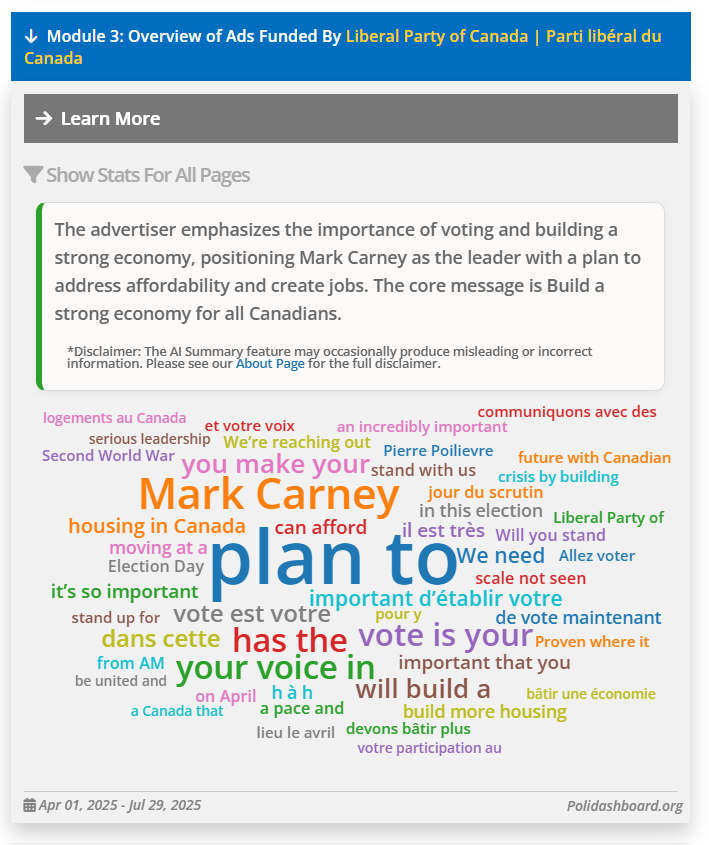
- We integrated a new AI Ads Summarizer into Polidashboard’s word cloud module. Users can now access clear, natural language summaries of the messages and themes in ads for any advertiser in our database, saving time and making it easier to decipher an advertiser’s aim.
2. New Semantic Search
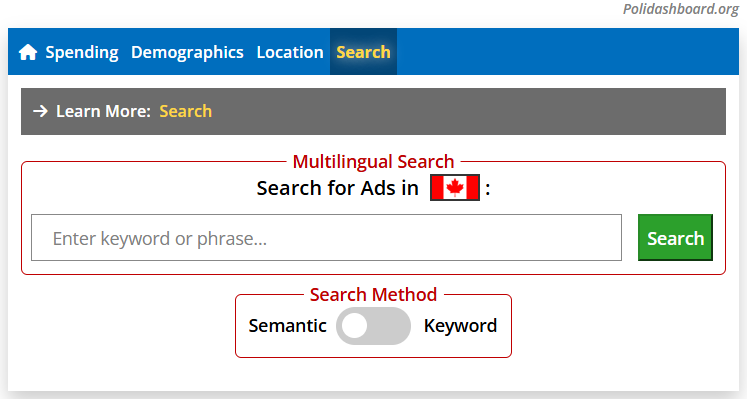
- We’ve introduced a new AI-powered Semantic Search feature, a cutting-edge tool that lets you explore our ad database by meaning rather than just keywords. Search for a topic or phrase, and we’ll surface advertisers whose ad copy is semantically similar, even if they don’t use the exact same wording. This is ideal for uncovering:
- Advertisers with shared political messaging or framing
- Coordinated ad campaigns
- Thematic patterns across seemingly unrelated organizations
3. Advanced Data Filtering
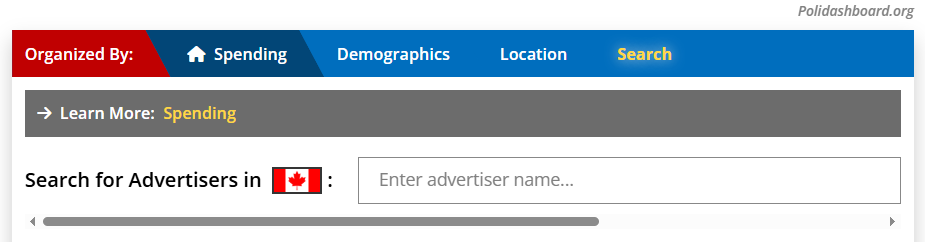
- We have added new ways to sort and filter ad data. Users can now filter political advertisers by spending levels, audience demographics, and location. This makes it easier to spot high-spending campaigns, regional targeting strategies, and outreach efforts aimed at specific demographic groups.
4. Enhanced Demographics Visualization with Interactive Demographic Drilldowns
- Our box plot visualization of advertiser demographics has been redesigned for clarity. Male and female audience stats are now displayed separately, enabling easy comparison across gender lines. This gives users a sharper view of how campaign messages are targeted differently.
- Every black dot on the demographics box plot now tells a story. Clicking on one reveals a bar chart showing the detailed demographic breakdown of the selected ad’s audience and a direct link to the ad itself. This makes it easier than ever to explore how specific messages are tailored to—and received by—different voter groups.


5. Infrastructure Overhaul
- We’ve completely overhauled our data infrastructure. PoliDashboard now runs on a PostgreSQL back end, offering faster queries, improved relational data handling, and greater scalability. This change lays the groundwork for deeper analytics and a smoother user experience across the platform.
Why It Matters
Transparency in digital political advertising is essential for a healthy democracy. Without oversight, targeted ads can spread misinformation or manipulate public opinion in ways that are hard to detect or trace. By making the hidden world of digital campaigning visible, PoliDashboard helps hold political actors accountable and provides the public with tools to understand how influence operates in today’s online political environment. These updates reflect our continued commitment to transparency, usability, and empowering researchers, journalists, and voters alike. More enhancements are on the way—stay tuned!
To explore the updated platform, visit: PoliDashboard.org
Media Contact
Philip Mai <[email protected]>
Social Media Lab, Toronto Metropolitan University
About the Social Media Lab
The Social Media Lab is an interdisciplinary research center at the Ted Rogers School of Management at Toronto Metropolitan University. It examines how social media and other digital technologies are transforming the way people and organizations communicate, share information, conduct business, and form communities, as well as the impact these changes have on society. The Lab’s overarching goal is to deepen public understanding of both the benefits and potential drawbacks of technology adoption.