
by Anatoliy Gruzd and Philip Mai
Public interest in the “51st state” controversy has risen sharply due to recent political events and heated debates around Canada’s national identity and sovereignty. Typically, discussions about potential U.S. statehood focus on places like Puerto Rico and Washington, D.C., but the conversation unexpectedly shifted in December 2024 after U.S. President-elect Donald Trump proposed that Canada should join the United States. Trump’s public statements and his social media posts claimed that there is supposedly widespread support among Canadians and emphasized economic and security benefits of joining the US. The suggestion triggered immediate backlash from the public and political leaders in Canada, with Prime Minister Trudeau stating that there “not a snowball’s chance in hell” Canada joins U.S.
This controversy significantly heightened public debate and intensified social media conversations. To better understand why social media engagement spiked on this issue, we analyzed ~60,000 public Facebook posts mentioning relevant words and hashtags such as “51st state”, “51state”, or “Never51st”, between December 1, 2024 and March 9, 2025. Facebook was selected for this analysis because it remains Canada’s most popular platform, making it ideal for gauging public opinion. The data, sourced from the Meta Content Library, includes publicly accessible posts from Facebook Pages, Groups, Events, and individuals with at least 1,000 followers or with a verified badge.
The main objective of our exploratory analysis was to pinpoint and understand key drivers behind the social media engagement observed. By examining how frequently specific political statements and noteworthy events were discussed, we identified patterns shaping online conversations.
Trend Analysis
A time series graph (Full-scale Version) shown below highlights spikes in Facebook post frequency related to provocative statements by Trump and counter statements made by other politicians. Notable peaks in engagement occurred following Trump’s explicit proposals about Canada joining the U.S. (Dec 18, Dec 25), provocative visual posts and commentary (Dec 3, Feb 3, Feb 10), and threatening remarks about economic annexation (Jan 7). Other significant spikes corresponded with major events amplified by Trump’s rhetoric, including Prime Minister Trudeau’s resignation (Jan 6), Canada’s response to new U.S. tariffs (Feb 2), Canada’s hockey victory over the U.S. at the 4 Nations championship (Feb 20-21), and influential media coverage highlighting the seriousness of Trump’s annexation threats (Mar 7).
Emoji Use and Public Sentiment
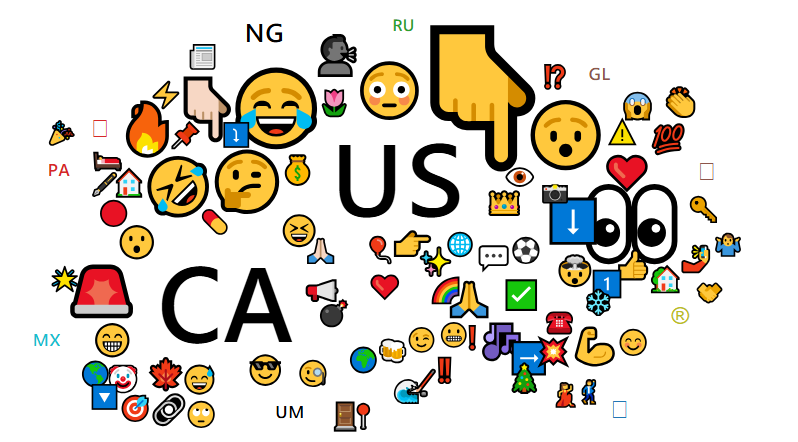
Alongside post frequency, we explored frequently used emojis within a subset of 5,073 posts that the Meta Content Library permits for detailed analysis. These posts were collected specifically from public Facebook Pages with 15k+ likes/followers, profiles with 25k+ followers, or profiles holding a verified badge.
Besides expected uses of the Canadian and American flag symbols (shown as the letters 🇨🇦 and 🇺🇸 in the emoji cloud), emojis like 😂, 🤣, 😳, and 🤔 indicated significant sarcasm and skepticism. The frequent use of alert emojis 🚨 and pointing-down emoji 👇 showed users actively highlighting Trump’s controversial remarks. Overall, these emoji patterns captured a mix of anger, irony, and critical reactions to threats to Canadian sovereignty.
Conclusions
Our analysis highlights Donald Trump’s significant influence on public discourse around the globe and particularly in Canada, where sensitivity to his rhetoric has grown considerably. What was once seen as mere provocation has increasingly taken on existential implications for Canadian sovereignty, identity, and political stability. As Trump’s rhetoric continues to shape public perception, policymakers and institutions must remain vigilant in tracking shifts in sentiment to address potential challenges and seize emerging opportunities. His statements not only influence domestic discourse in the United States but also have far-reaching effects on international relations, trade, and security—factors that directly impact Canada. Understanding these dynamics is crucial for crafting informed policies that protect national interests and maintain stability.