
Ukraine and the West have long been a target of the Kremlin’s disinformation campaigns. Since the annexation of Crimea in 2014, Russia has used a variety of information warfare tactics to destabilize the Ukrainian government and undermine the legitimacy of democratic governments the world over.
In recent years, as part of Russia’s bid to shape public perception of their action on the world stage, Russia has deployed an army of bots, trolls, hackers and other proxies to create a more favourable information environment for their agenda in Ukraine and other areas of geopolitical interests.
For example, during the leadup to the 2016 U.S. federal election, the Kremlin used the now-infamous “Internet Research Agency” to sow discord online and on the streets of America. The use of such hybrid warfare tactics has intensified since Russia invaded Ukraine on February 24, 2022. For instance, since the start of the invasion, the Social Media Lab’s Russia-Ukraine Conflict Misinformation
Dashboard has tracked thousands of false, misleading, and unproven claims related to the Russia-Ukraine war.
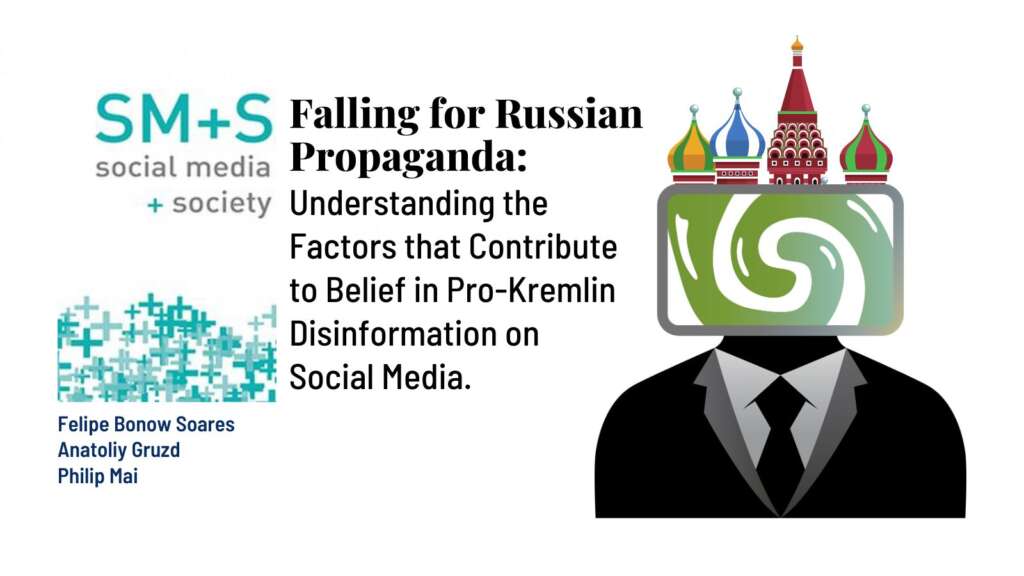
Building on a public report the Social Media Lab released in 2022, our new study, “Falling for Russian Propaganda: Understanding the Factors that Contribute to Belief in Pro-Kremlin Disinformation on Social Media,” examines the factors that predict belief in pro-Kremlin disinformation narratives regarding the Russia–Ukraine war.
The study, recently published in the journal Social Media + Society, used linear regression analysis to analyze data collected via a national survey of 1,500 adults (18+) that belief in Pro-Kremlin disinformation is politically motivated and linked to users who:
- hold conservative views,
- trust partisan media and
- frequently share political opinions on social media.
For more details on these findings, you can download the full paper here.
Citation:
Soares, F. B., Gruzd, A. & Mai, P. (2023). Falling for Russian Propaganda: Understanding the Factors that Contribute to Belief in Pro-Kremlin Disinformation on Social Media. Social Media + Society, 9(4). DOI: 10.1177/20563051231220330