
The pandemic is a top issue among political advertisers on Facebook as Canada’s COVID-19 cases decline, restrictions ease and provinces take steps to reopen their economies. But, other issues are rising to the forefront, particularly policing and the environment. As a continuing part of our transparency initiative, we are looking each month at some of the top advertisers on Facebook and the issues on which they hope to influence Canadians’ thoughts and opinions.
In April, charities, NGOs and health care organizations seeking donations to support their efforts in the battle against the virus were among the top advertisers. In May, we found advocacy groups entered the list, though some advertisers were still focused on responding to COVID-19. In the last week of June, the pandemic continues to be top of mind for some advertisers, but others are moving on to other issues as outlined below.
Top 25 advertisers
Using the Social Media Lab’s Polidashboard, which collects data from Facebook’s Ads API, we examined the trends and issues that emerged among Facebook’s top advertisers from June 24 to 30. There were a total of 2,554 ads over this time, down 18% from the last week of May. See Table 1 below.
Table 1: Top 25 Canadian political advertisers on Facebook (June 24-30)
| Money Spent (CAD) | 0-99 | 100-499 | 500-999 | 1000-4999 | 5000+ | Total | Amount spent | |
| 1 | David Suzuki Foundation | 256 | 11 | 1 | 2 | 0 | 270 | $4,800 |
| 2 | Peter MacKay | 164 | 29 | 6 | 13 | 1 | 213 | $6,465 |
| 3 | National Police Federation | 153 | 36 | 12 | 7 | 0 | 208 | $3,996* |
| 4 | Oxfam Canada | 183 | 7 | 0 | 0 | 0 | 190 | $2,500 |
| 5 | Stand.earth | 170 | 13 | 0 | 0 | 0 | 183 | $792 |
| 6 | Doctors Without Borders/ Médecins Sans Frontières (MSF) | 95 | 45 | 21 | 10 | 2 | 173 | $26,225 |
| 7 | No To No Fault | 129 | 9 | 2 | 1 | 0 | 141 | $2,495 |
| 8 | UNHCR Canada | 54 | 45 | 16 | 13 | 2 | 130 | $24,779 |
| 9 | Liberal Party of Canada | Parti libéral du Canada | 117 | 2 | 0 | 0 | 0 | 119 | $789 |
| 10 | Amnesty International Canada | 68 | 27 | 14 | 8 | 1 | 118 | $6,681 |
| 11 | Greenpeace Canada | 77 | 20 | 1 | 0 | 0 | 98 | $1,666 |
| 12 | The Fraser Institute | 70 | 2 | 0 | 0 | 0 | 72 | $755 |
| 13 | Alberta’s NDP | 41 | 16 | 7 | 7 | 0 | 71 | $2,076 |
| 14 | Canadian Association of Petroleum Producers (CAPP) | 47 | 14 | 6 | 3 | 0 | 70 | $565 |
| 15 | UNICEF Canada | 29 | 20 | 4 | 8 | 0 | 61 | $8,269 |
| 16 | Community Building Standard | 48 | 6 | 3 | 1 | 0 | 58 | $598 |
| 17 | Saskatchewan Party | 43 | 10 | 0 | 0 | 0 | 53 | $1,086 |
| 18 | Ontario Medical Association | 38 | 9 | 3 | 3 | 0 | 53 | $421 |
| 19 | UnSmoke Canada | 7 | 19 | 10 | 15 | 1 | 52 | $24,393 |
| 20 | Plan International Canada | 27 | 11 | 3 | 5 | 1 | 47 | $5,486 |
| 21 | Alberta Federation of Labour | 5 | 26 | 8 | 5 | 0 | 44 | $4,484 |
| 22 | Holland Bloorview Kids Rehabilitation Hospital | 34 | 0 | 0 | 0 | 0 | 34 | Less than $100 |
| 23 | Canadian Taxpayers Federation | 18 | 11 | 4 | 0 | 0 | 33 | $14,266 |
| 24 | Ministère de la Santé et des Services sociaux (MSSS) | 2 | 19 | 3 | 6 | 3 | 33 | $1,062 |
| 25 | Innovative Medicines Canada | 15 | 8 | 2 | 5 | 0 | 30 | $1,440 |
* The federation owns two Facebook pages, but the amount only reflects spending by the National Police Federation page.
Top advertising themes
Though the top advertisers cover a variety of issues, like protecting the environment, human rights, policing and promoting Canada’s energy industry, seven key themes emerged from a closer review of the top 25 advertisers and their ads.
1) Advocacy groups
Advocacy groups remained the most common advertisers during this period, with six advertisers falling into this category.
The National Police Federation was the number three political advertiser on Facebook between June 24 and June 30. Over this period, the federation spent $3,996 and bought 208 political ads, according to Facebook’s ad library.

The police federation has been among the top political advertisers on Facebook for the past three months. In the last week of April, it was the eighth-largest advertiser, with 93 ads from April 24-30. In the last week of May, the federation decreased its advertisements in the last week of May and dropped to a three-way tie in 19th with 48 ads between May 25-31.
The Defund the Police movement has risen in prominence since the death of George Floyd on May 25 by a Minneapolis police officer who knelt on his neck for eight minutes and 46 seconds. The federation’s advertisements emphasized the service of RCMP members across Canada. Several ads include images of RCMP members with families in front of homes and all ads feature the same message in French and English: RCMP members are proud to serve Canadians. Though the federation’s ads do not directly address the defund the police movement, it has almost doubled the number of ads it had on Facebook at the end of June over a month prior. The federation also owns the page Surrey’s Say on Policing. Some ads on this page include videos of Surrey RCMP members discussing policing in the city, which is transitioning from the RCMP to a local police force.
The pandemic remains a key issue for some pages, who used their advertisements to highlight rebuilding the economy as the pandemic wanes in Canada or to support at-risk communities where COVID-19 cases remain high. Environmental and climate groups stand out. The largest advertiser over this period was the David Suzuki Foundation, which entered the list of top advertisers with 270 ads. The foundation spent $4,800 in this period and all but 14 of its ads cost less than $100. The foundation’s ads encouraged a green recovery with a focus on the environment and climate change as Canada’s economy rebuilds from the pandemic.

Greenpeace Canada shared a similar message of protecting the environment during the pandemic. The group increased its advertising slightly in the last week of June with 98 advertisements, up from 74 in the last week of May. After ranking among the top 10 advertisers for the third month running, Stand.Earth has reduced its advertising on Facebook. The organization had purchased 183 ads in the last week of June, down from 267 in the last week of April and 247 in the last week of May, and it didn’t have any active advertisements on Facebook by the beginning of July.
Some ads targeted issues that are unrelated to COVID-19. No to No Fault used its Facebook advertisements to oppose a move to no fault insurance rules in British Columbia. The group boosted its advertising in the last week of June to place eighth with 141 ads, up from 11th in the same period in May.
2) NGOs
NGOs remained among the top advertisers on Facebook in the last week of June as six groups were identified in this category: Doctors without Borders/Médecins Sans Frontières (MSF), Oxfam Canada, UNHCR Canada, Amnesty International Canada, UNICEF Canada and Plan International Canada. The Pandemic has remained a key theme among NGOs, who used their ads to raise donations or encourage action to address areas that have been impacted by COVID-19.
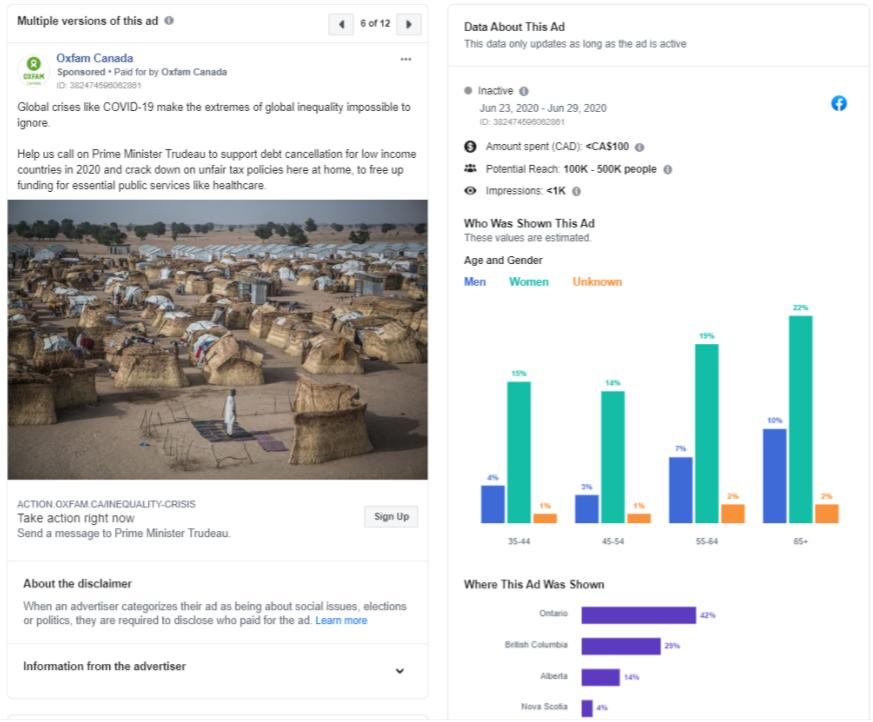
Oxfam, UNICEF Canada and Plan International Canada were new to the top 25 list. Oxfam Canada emerged as the fourth largest Facebook advertiser in this period with 190 ads. The group used its ads to call for action to tackle poverty and inequality in less developed countries, as well as debt forgiveness and cracking down on tax havens and tax evasion to support health care and public services.
Plan International Canada used its ads to highlight the impact the pandemic has had on girls and women in developing nations. It ranked no. 20 with 47 ads in the last week of June and $5,486 spent.
Doctors without Borders/Médecins Sans Frontières (MSF) spent the most on Facebook ads in this period, spending $26,225 for 173 ads. While some of the group’s ads asked people to donate to help its efforts fighting COVID-19 internationally, others highlighted efforts in other areas such as combating Ebola or high maternity and neonatal mortality rates in South Sudan.

3) Business lobby
Four advertisers were focused on a range of business and economic issues, from energy production, to building standards and pharmaceutical production.
As it did in May, UnSmoke Canada used its advertisements to ease advertising regulations for vaping. UnSmoke Canada is a website run by Rothmans, Bensons and Hedges, Inc. It encourages people to quit smoking or to move to alternatives to cigarettes. UnSmoke spent $24,393 in the last week of June on 52 advertisements, increasing its dollar total from $13,000 in May. The move comes as advertising rules for vaping are tightening across Canada, including in Ontario where new regulations came into effect at the beginning of July.

As a search for treatments for vaccines and treatments for COVID-19 ramps up Innovative Medicines Canada, a representative for Canadian pharmaceutical companies, sought to highlight research by Canadian firms in this area with its advertisements. It spent $1,440 for 30 ads in the last week of June, enough to rank 25th overall, but it no longer had any active ads at the start of July.
The Canadian Association of Petroleum Producers (CAPP) continued its presence as a top advertiser on Facebook with 70 ads in this period, mostly unchanged from the last weeks of April and May when it bought 69 ads in both periods.
4) Politics
Canadian political parties are reemerging as top advertisers on Facebook after largely refraining during the height of the pandemic. Three political parties and one politician ranked in the top 25.
Conservative Party leadership candidate Peter MacKay ranked second in the last week of June with 213 ads. Though the party postponed its leadership race in March, MacKay spent $6,465 for 213 ads in the last week of June. MacKay spent almost twice as much on ads over the same period in May to buy 168 ads. His ads run in French and English and include a range of messages, from asking people to fill out surveys, to targeting Prime Minister Justin Trudeau or saying MacKay would not allow China’s Huawei to be part of Canada’s 5G infrastructure, as seen in Figure 6 below.

The Liberal Party of Canada – which ran 119 ads June 24 to 30 – had the most ads among Canadian political parties. Its ads primarily asked people to fill out a survey on policy priorities and donate to the party.
5) Health care
Health Care organizations continued to use advertising on Facebook to highlight fight against COVID-19 in Canada as three groups fell in the top 25: the Ontario Medical Association, Holland Bloorville Kids Rehabilitation Hospital and Ministère de la Santé et des Services sociaux (MSSS), Quebec’s Ministry of Health and Social Services.
In terms of dollar amounts, Quebec’s health ministry was the fourth largest advertiser as it spent $14,266 for 33 facebook ads in the last week of June. The ministry has run ads in multiple languages to promote prevention measures to stop the spread of COVID-19.
6) Think tanks
One think tank, Vancouver-based Fraser Institute that has been described by some as politically conservative and libertarian, boosted its Facebook advertising in the last week of June with 72 ads, up from 38 in the last week of May. The institute’s ads encouraged people to sign up for newsletters and information about the government’s response to COVID-19.
7) Union
One union, the Alberta Federation of Labour, was among Canada’s top 25 political advertisers on Facebook in the last week of June, spending $4,484 for 44 ads. The union’s ads largely targeted Alberta Premier Jason Kenny from the United Conservative Party , while also calling for protection of workers during the pandemic and to enhance workplace safety protections.
And the beat goes on…
As we saw in April and May, advocacy and calls for donations continue to be the main themes advertisers are looking to get across through political advertising on Facebook. COVID-19 remains the top issue among a range of different advertisers, even as others like business issues, policing and government policy continue to be a part of the online conversation. We also continue to find some advertisers rank among the top 25 after three months, even as others have increased their advertising. And, political parties are starting to increase their advertising after cutting back during the peak of the pandemic. COVID-19 may be on the decline in Canada, but numbers are rising elsewhere. It continues to be one of the top issues facing Canadians and people around the world. As some advertisers look to bring other issues to the forefront, it is more critical than ever to make sure that those who are looking to influence public opinion do so in a transparent manner.
Post by: Donald Patterson, Anatoliy Gruzd, & Philip Mai